|

Click Here for Recent Quote

Important Investor FAQ (Frequently Asked Questions) Appear Below. Please do read the full text of the questions and answers to be well informed. The information below is as at June 15, 2009.
- When are earnings due to be reported and are revenue and profit goals being attained?
- What is sales growth YOY and Qtrly YOY. Meeting or exceeding expectations?
- Does your leadership team have a stock appreciation timetable that you work from? Do you update this and how often?
- With huge successful firms in your sector whose sales are in the tens of billions of dollars annually, like Procter & Gamble, Unilever and Colgate to name only a few, how will Winning Brands compete? Can't they simply "squash" you?
- Is the stock being shorted? Have you followed up on this and is it resolved?
- Are the primary shareholders 144 Stockholders? How much stock is held by insiders and institutions? How many shares are in the float?
- As CEO, what plan do you have in place to increase shareholder value? Are there any details you can share about this plan?
- How many analysts (if any) are tracking your company, its stock and products in Canada and the USA? How soon before we get an analyst review of your stock and its performance?
- With the positive headlines on Yahoo or other information sites, or even your Pink Sheets Stock page, how is it that the stock is depressed from earlier prices.
- With the obvious success of your dry cleaning products, how soon before you penetrate one of the world's largest economies, California? The California legislature is planning to ban Perchloroethylene in all dry cleaning facilities.
- Which brokerage house handles your equity (shares)?
- Do you have any overall summary?
- Although the FAQ states Winning Brands is financially sound and ahead of schedule, can you comment a bit further? (Anything would help out.)
- Is there a chance you'll report, or post for viewing, audited numbers near the end of 2008?
- Is the chemistry and products presented by WNBD certified “green” by an accepted governmental/scientific authority?
- What is Winning Brands’ attitude toward “private labelling” as a form of growth for itself?
- What is the policy of Winning Brands toward Reverse Splits?
- If the company has reverse split stock before (2004), will it happen again suddenly?
Q1: When are earnings due to be reported and are revenue and profit goals being attained?
A: Winning Brands Corporation (WBC) is a young public company, and is still officially a “Non-Reporting Issuer”. This status of Non-Reporting Issuer means that it is not yet required by U.S. SEC (Securities and Exchange Commission) regulations to follow the conventional public company financial disclosure regime. However, the company has audited financial statements for the year on which the reverse merger is based as a matter of good governance and for the purpose of continuous quality improvement toward a best practices culture. The company is accumulating information for possible future disclosure; probably first as an Issuer Information Statement, however the release of this information is predicated on certain factors described below.
Firstly, the firm does not wish to provide information of premature assistance to competitors. Long term financing and organizational strategies should be finalized first, including plans to access international capital markets, so that they can be reflected in the financial statements. Without this, the statements would not sufficiently reflect the ability of the firm to achieve its goals and thus provide unjust advantage to competitors or other parties for whom the best interest of the company were not the top priority.
Also, the enormous cost of formalizing conventional full reporting status is more appropriately incurred in connection with a significant public share subscription. Shares currently being traded are in part shares that already existed at the time the private company became publicly trading as well as shares issued to individual qualified subscribers under the Regulation D, Rule 504 exemption who hold the shares for investment purposes, but may eventually sell all or part of their holdings to new buyers. Therefore, the current Non-Reporting Status provides the firm with needed flexibility to develop its financing and organizational options. The firm does not wish to imply that a conventional full reporting status is a certainty. Investors should not base share purchase decisions on such an expectation. Please to take this cautionary note seriously because management of Winning Brands Corporations does not wish to mislead persons purchasing shares on the open market as to the nature of future capitalization. It is an area still under review by management in concert with its evolving business plan.
The company is permitted to make informal interim disclosure of certain financial and operational details so long as the method of disclosure is not preferential to some persons over others. This will help shareholders have a "rough idea" and thus avoid substantially inaccurate assumptions. The Winning Brands Corporation website is accessible to all persons equally as a source of comments for attribution and information. Accordingly, the following comments will be very helpful to investors by disclosing the company's general operating assumptions and risks.
WBC has designed its business plan to pass through 6 Phases. These phases are not based on the calendar, but rather on business developments; Initial Operations Phase (Annual Sales less than $1 Million), Implementation Phase (Annual Sales of $1 Million to $3 Million), Growth Phase (Annual Sales of $3 Million to $5 Million), Self-Sustaining Phase (Sales between $5-50 Million), Established Phase (Sales between $50 Million and $100 Million), World Phase (Sales over $100 Million).
Winning Brands was in the Initial Operations Phase when the reverse merger of Niagara Mist Marketing Ltd and Winning Brands Corporation was announced in 2006. The Initial Operations Phase is characterized my more research and production of samples than sales and more testing than actual distribution. In general terms, this can be thought of as the phase during which the starting foundation is laid for the subsequent phases. It is expected to come to an end within 2008 so that in 2009 the firm can enter the Implementation Phase. The Initial Operations Phase was not expected to be a profitable phase. Operational developments of a material nature during the Initial Operations Phase were disclosed by means of News Releases. The Implementation Phase for WBC is likely to be realized in 2009 as U.S. activities pick-up. This represents a delay of several months, as the implementation of a business relationship with a major U.S. national retailer(s) is more likely to be manifest at the store level in 2009. A portion of 2008 production has been allocated to a consumer sampling program to create widespread customer experience with lead products, rather than waiting for the U.S. store listings to become operational. This means that the investment in the production of samples, and the shipping of samples, will not be recorded as sales for the purpose of determining the applicable operational Phase. It is important for investors in an early stage firm of this type to realize that the company's potential resides in its growth prospects within the increasingly important environmental sector - not the company's early financial position. This is a factor common to early stage entrepreneurial companies. There is likely to be an evolution of its financing plans to address emerging opportunities. Most capitalization options available to the company run in concert with the company’s operational prospects. Financing and Operations are therefore more closely related than in more established companies. An investment in Winning Brands Corporation is therefore highly speculative but takes place within a sector that is widely regarded as growing.
WBC management avoids promotional exaggeration which might stimulate buying of shares based on unrealistic projections. Accordingly, because of the company's realistic targets and logical progression of operations, the company can state that it is currently meeting its declared expectations of sales/expenses and operational outcomes commensurate with the anticipated conclusion of the Initial Operations Phase.
This website and the company's News Releases are the company's only official comments for attribution. Any claims made for the company, or about the company in other places, even if intended to appear similar, may not reflect the opinions of the company or its management. You are invited to contact us at anytime by e-mail to request verification of a statement made by any party claiming to represent the company.
TOP
Q2: What is sales growth YOY and Qtrly YOY. meeting or exceeding expectations?
A: As compared with 2006, sales were growing in 2007 and 2008 including re-orders from new accounts based on satisfaction with early results. However the sales remained in the Initial Operations Phase for the purpose of this disclosure. Please see the applicable News Releases for details. Although no assurance can be given that the goal will be reached, it is the company’s revised goal to leave the Initial Operations phase and enter the Implementation Phase in 2009. Progression from one phase to the next is not necessarily steady but rather related to key events that represent “tipping points”, such as the decision by a retail chain to move from testing Winning Brands products to actually listing, or to move from a regional listing of products to a national listing, changes in production capacity or to add a second product SKU to an existing listing, etc. Winning Brands management feels that 2008 operations benefited from several such tipping point events that are a natural consequence of the preliminary work done in the Initial Operations Phase. For the sake of clarity, securing a listing for the company’s products is not a guarantee of success for the product in the retail environment. Considerable work may be necessary at the store level with retailer staff in order to create product knowledge and to train sales people as to the nature of the products and their competitive position. Launching a new brand does not usually proceed according to a linear progression. The role of tipping points and unexpected support issues should not be underestimated as factors affecting success. Investors should be cautioned that the firm may require resources which are not available at the correct time in order to optimize all pertinent influencing factors.
TOP
Q3: Does your leadership team have a stock appreciation timetable that you work from? Do you update this and how often?
A: Management strives to generate business reasons that support a healthy share price. However the shares of Winning Brands Corporation are in the most highly speculative segment of the equities market currently because the firm is young. It is operating with high risk factors – the business is not yet proven in its marketplace. Conventional valuation techniques do not apply because the primary assets of the company are its proprietary methods, formulas and trademarks that have yet to become established amongst customers.
It is therefore not possible to create short term conventional share price forecasts based on the traditional equity valuation parameters until the firm becomes more established. In due course, it will be possible to apply Price/Earnings Ratios, Book Value Ratios and other conventional tools of prediction as the basis of setting share price targets. In the speculative sector of the market, there is much subjective projection at work in estimating future possible share price performance.
The primary consideration for any investor in a company that is at such an early stage of development is whether the company is likely to survive the most challenging stage of (any company's) life - the early years.
Over the long term, if the Winning Brand Corporation establishes itself as a brand portfolio in the international markets that WBC is targeting, then it may be possible at a P/E Ratio of 25:1 to achieve share price targets of U.S. $2.50 per share for every $100 Million in sales. This assumes that the issued and outstanding share count is 250 Million, (which would require a consolidation from the current number of shares outstanding) and that the company is profitable with planned structures are in place. It is the company’s preference to achieve as much of the share consolidation as possible through a share-buy-back program if the company achieves profitability. A variation of the formula that has been applied to these variables may be necessary from time to time to accommodate adjusted factors. Therefore, if the company succeeds, then there is substantial upward potential for the shares from the current start-up trading range. This is highly speculative however and does not constitute professional investment advice. Winning Brands Corporation management encourages prospective share purchasers to use conservative prudence in assessing personal risk tolerance. The firm does not wish to cause persons to experience capital loses through unrealistic expectations or due to factors beyond the company's control.
The ability of the company to reach its targets is affected by variables in the market for the company's products, the ability of the company to finance expansion, the possible loss of key management at any time and many other factors beyond the company's control. The purpose of such targets is to define goals and measure of progress for its products and for shareholder value.
The company is likely to rely on shareholder dilution as a means of raising working capital in the interim. in terms of outstanding share count, the resulting market capitalization may still represent a low valuation by the standard of upwardly mobile entrepreneurial firms that have potential international reach for their products. The value of intellectual property such as trademarks and trade secret formulations is difficult to gauge, and ultimately relies on subjective factors. It is the company’s position that a reasonable subjective valuation of these assets in the Winning Brands portfolio of less than U.S. $10 Million does not adequately reflect the replacement cost of the company’s intellectual property and account listings if they were created from a zero starting point.
TOP
Q4: With huge successful firms in your sector whose sales are in the tens of billions of dollars annually, like Procter & Gamble, Unilever and Colgate to name only a few, how will Winning Brands compete? Can't they simply "squash" you?
A: There is a widespread misunderstanding about the nature of competition as between "giants" and emerging companies. There is a role for both and they have differing objectives. In fact, they benefit from each other's existence.
The largest firms like the ones you have mentioned are in many ways the standard bearers. They have developed mature organizational structure and best practices in much that they do. They provide stability to the industry and to society. However it is in the nature of large organizations that they are better at being stable than being innovative. This is due to internal vested interests that things be done a certain way. It is a natural and normal condition within all large organizations.
On the other hand emerging firms are more inclined to take risks. By being unconventional, smaller firms are in fact providing a form of research and development to society and to the larger firms. Ultimately the largest companies would prefer a Mergers and Acquisitions response to emerging success stories than to use tactics that would bring dishonour to their own employees, stakeholders and customers. Accordingly, the largest firms can be thought of as mentors and are known to acquire firms or brands that they view as extraordinary.
The greater competitive risks come from smaller emerging companies with less to lose by engaging in tactics that are unethically disruptive or high risk.. There are many intelligent people and companies in the world being innovative at any moment in time. The largest companies are often the most responsible but also the most conservative (by necessity) in the way they conduct themselves.
Winning Brands Corporation operates on the principle that competitors may offer lessons of how to be better at what one does. Therefore the most predictive indicator of a company's ability to operate in a competitive environment may be its willingness to learn continuously and putting the customer first in decision making.
The demand for safer alternatives to hazardous chemicals in widespread use, including cleaning products, is so vast, and growing, that it can sustain huge companies. In aggregate, the conventional market for these products already account for hundreds of billions of dollars in annual sales. Winning Brands Corporation does not need to make huge inroads in order to become an unqualified success in its own right.
TOP
Q5: Is the stock being shorted? Have you followed up on this and is it resolved?
A: WBC relies on investment professionals to operate within the regulations and guidelines for short selling or any other trading decisions. Management of the company provides the public with an above average level of disclosure for a Non-Reporting Issuer of its size and its stage of development so that shareholders can reasonably gauge the general direction the company and thereby make reasonable personal choices.
Management requests that shareholders alert it of specific instances of any market activity which is of concern to them by means of supplying specifics sufficient to research the matter.
TOP
Q6: Are the primary shareholders 144 Stockholders? How much stock is held by insiders and institutions? How many shares are in the float?
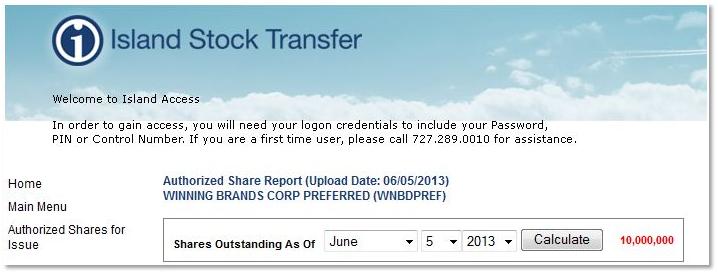
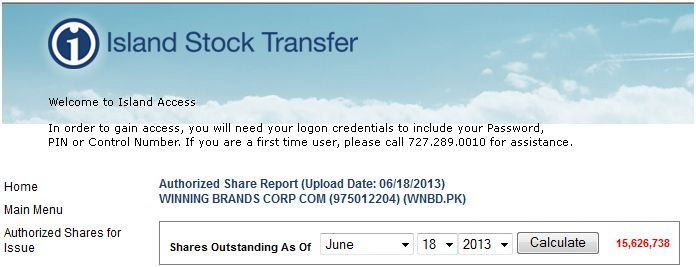
A: As at June 15, 2009 THE ENTIRE FLOAT OF AVAILABLE FREE TRADING STOCK of Winning Brands Corporation is approximately 1,074,837,353 shares. These are the only common shares available for trading. This is because 150 Million of the 1,224,837,353 issued and outstanding common shares are still restricted from trading under "144" provisions and not in circulation. These restrictions no longer expire automatically in the 1st Qtr 2008 as they would have originally according to their issuance in 2006 because of new regulations pertaining to the conversion of restricted “144” shares. These new regulations, which are still being evaluated, may have the effect of prolonging the effective restriction period indefinitely and preventing their conversion into free trading shares at all under the company’s current registration status. Most of these common shares are held by company management, employees and co-founders who are still with the firm. Management is not aware of an intention by any of these holders to presently pursue a conversion of their restricted holding. 5 billion common shares are authorized and 10 Million Preferred Shares; the Preferred Shares which were provided for in the 2006 Agreement of Merger and Plan of Reorganization between Winning Brands Corporation and Niagara Mist Marketing Ltd should also be treated as issued, although they are not tradable in capital markets in order to protect the financial interests of common shareholders. The Preferred shares have the effect of providing continuity of voting control by the founding group of Niagara Mist Marketing Ltd since the reverse merger of Winning Brands Corporation with Niagara Mist Marketing Ltd in 2006. This is further referred to elsewhere in the FAQ. The reverse merger was announced in the company’s News Release Number 1 in April 2006.
TOP
Q7: As CEO, what plan do you have in place to increase shareholder value? Are there any details you can share about this plan?
A: Shareholder value ultimately reflects the desirability of the company in its marketplace, both for its products and it shares.
Desirability is in turn derived from legitimate success in material terms through the growth of assets (physical or intangible), goodwill and brand recognition.
The plan of the CEO of Winning Brands Corporation, Eric Lehner, is to remain focused on making progress toward long term fundamentals. Mr. Lehner has remarked publicly on many occasions that the tendency of North American companies to plan for short term gains over long term achievement is overdue for a change. The emerging global economy mixes practices of successful companies and societies with longer term horizons. There is in his view an increasing sophistication in the standard which is applied to the term "success". Socially responsible work environments, meaningful interaction with customers, continuous quality improvement are only some of the "new" basics according to Mr. Lehner.
He feels that the days of chasing immediate bumps in earnings, unnatural price-per-share movements or any other measurement of the company's progress are discredited by the emergence of massive long term thinking organizations whose businesses span generations and continents.
Any prospective investor should know that Winning Brands Corporation's mission of replacing hazardous chemicals in widespread use with safer alternatives is designed to last a lifetime as "work worthy of a generation". The company's progress in being part of the solution for a world whose ecosystems are under stress, rather than being part of the problem, requires an evolution in the public's behaviour as well. Such changes amongst the public do not come easily or quickly, as habits are difficult to change.
On a strictly business level, Winning Brands Corporation is exceptionally well positioned to benefit from the increasing urgency in these matters. Governments are beginning to impose regulations which are ahead of the public's level of awareness. All WBC products are designed with this in mind.
It is the official planning precept of Winning Brands Corporation that Climate Change (often described as Global Warming) is a real phenomenon and worsening. WBC is acting now to position itself to be relevant with cleaning solutions (and perhaps other chemicals) which are oriented toward improving the status quo of water quality internationally. Water quality is not directly related to CO2 emissions and carbon load as a causative element, but plays a part in preserving the eco-integrity of all natural bodies of water whose eco-systems will be under new stresses.
Changing characteristics of ocean currents, precipitation, evaporation, non-native species of plant life, insects and other biological content in lakes, rivers and the seas all tax the ecosystems to work hard in coping with change. In other words, these factors are all interconnected. Winning Brands Corporation designs cleaning solutions that are as beneficial as possible, thus will experience increasing demand.
Shareholder value can also be increased through mergers and acquisitions activity. As at December 5, 2007 WBC is not actively pursing, nor being pursued in M&A talks, however such developments may arise when certain operational factors reach tipping points described above.
A further means to increase shareholder value is to make best use of the infrastructure of distribution and production partners in order to keep the sales per employee level attractive and apply capital toward marketing investments, including R&D.
The use of suitable contract packaging services is an example of how WBC can minimize increases in staff yet participate in fluctuations of production work, thus providing an increase in capacity without the associated fixed capital costs.
TOP
Q8: How many analysts (if any) are tracking your company, its stock and products in Canada and the USA? How soon before we get an analyst review of your stock and its performance?
A: There are few analysts tracking the company currently. Instead, an active (growing) group of retail investors are currently the primary followers of the company. This is likely to change if WBC is targeted by green oriented investment funds. It is the objective of WBC over the long term to qualify for investment by Ethical Investment Funds of various types to fund significant step-up adjustments to the company's operations over time. The company is as selective of its investment partners as it is of its business planning precepts.
TOP
Q9: With the positive headlines on Yahoo or other information sites, or even your Pink Sheets Stock page, how is it that the stock is depressed from earlier prices.
A: It is in the nature of speculative stage companies that their share price changes can be dramatic up or down or back up again. The volumes may also fluctuate greatly.
Furthermore, the supply of WBC common shares on the market has been relatively higher than the demand for it, creating a trading situation which favours buyers over sellers by depressing the share price. This situation will end in conjunction with the firm advancing through its phases of growth. As the firm draws its working capital increasingly from operating cashflow, the relative supply of shares vs the relative demand for them will diminish; either through a cessation of issuance, or the company’s re-purchase of shares in the markets if the market cap valuation remains below what the company considers appropriate, as is the case currently. A reverse split, or consolidation of shares is always possible, however the firm has been conservative in this regard to ensure that any such move can be accompanied by factors which are favourable to the maintenance of the higher share price that follows from a consolidation.
It is also possible (and often the case) that early entrants are traders wishing to capitalize on such short term swings, covering positions for many reasons that may be unrelated to the company's progress. This may include persons who had been granted equity compensation for services rendered in the early days, where this is permissible. The firm has adopted conservative policies in respect of such activities so as to continually reduce the portion of the float that has this feature.
Management of WBC respects and appreciates the decision by any person or institution to become a stockholder. Management must therefore also be concerned about the long term appreciation in the value of investor holdings. The official policy of WBC however is to discourage short term positions for the simple reason that the cycles by which major increases in shareholder value occur are longer than mere days, or even months in duration.
WBC is possibly attractive for the speculative investor who seeks substantial growth in the value of their holding but has the willingness and capacity to treat the holding as a long term participation in fundamental and world wide shifts that favour environmentally responsible companies.
It is the opinion of the management of WBC that the company will benefit increasingly from heightened awareness of ecological problems that appear to be growing in scope internationally. Human health safety is an increasingly important component in the definition of ecological equation. Winning Brands Corporation products are deliberately designed to be as neutral or even beneficial in this respect as possible.
WBC products are designed to be effective, not only safe. Therefore there may be more rapid growth in distribution of the company's products than slower moving mega-trends described above. When material developments happen, they are disclosed as News Releases. Individual investors then decide to what extent these developments support an expectation that the company will attain its goals in the near term and long term.
TOP
Q10. With the obvious success of your dry cleaning products, how soon before you penetrate one of the world's largest economies, California? The California legislature is planning to ban Perchloroethylene in all dry cleaning facilities.
A: The realistic answer is that it is a conversion that will be ongoing over many years, probably a decade or more - and not necessarily centred in California. With the speed of information exchange today, historical differences between jurisdictions in most matters is a diminishing characteristic. A larger, interconnected worldwide community of persons who are thinking globally and acting locally is replacing historic political boundaries. The implications are gradual but cumulative and can be seen all around us. Our work will be equally relevant across America.
WBC management operates on the premise that most change is met by resistance. This resistance in its most innocent form can be lethargy. It can have more self-serving aspects, such as the protection of existing vested interests. Of greatest concern would be pro-active undermining of the type that would try to stop the agents of positive change.
It is not possible to predict how emerging new regulations for Dry Cleaners in California and other jurisdictions will be met over the long term. WBC management assumes that there will be aspects of all these styles of response present over the coming years.
Therefore, it is the company's policy to remain focused on establishing a positive model of progress for Dry Cleaners who are willing and ready to apply these benefits to themselves and their customers. In practical terms, this means continuing to establish working sites that are satisfactory to the business people who own them, their clients' cleaning results and to governments as examples of what can be done to reduce toxic load in our economy and in the environment. As of December 5, 2007 there are a number of such sites in operation – all supporting WBC’s contention that professional Wet Cleaning with the company’s SMART™ Wet Cleaning System provides the world’s most attractive combination of operating characteristics for the Dry Cleaning wishing to end their use of Perchloroethylene.
The decision by Greenpeace to speak out in favour of non-toxic alternatives to Dry Cleaning in their research entitled "Dress to Kill" has been raising consciousness of this subject internationally. The progressive stance of the United States Environmental Protection Agency (EPA) in which the use of Perc is strongly discouraged is also predictive of future development in this category.
It is possible that the trend line for the adoption of non-Perc Dry Cleaning will be analogous to the trend line for the adoption of Hybrid vehicles; a minority of early adopters who through their success with the new paradigm will stimulate a second wave. We are still in the early adopter phase. As anyone who has followed the strong surge of interest in such Hybrid vehicles, the tipping point has certainly been reached that what was once “fringe” is now becoming “mainstream”. The leading brand in this category is experiencing waiting lists, price over MSRP levels and strong awareness by the public (and legislators).
TOP
Q11: Which brokerage house handles your equity (shares)?
A: In general terms any full service and duly accredited investment dealership has the capability of arranging for the acquisition or sale of shares in Winning Brands Corporation (WNBD) Pink Sheets in USA, Canada or internationally. A registered broker/dealer that is most familiar with the company is JPC Capital Partners near Atlanta Georgia. www.JPCCapital.com
TOP
Q.12: Do you have any general words or summary?
A: Winning Brands Corporation is driven by a mission to be successful. Its managers and staff are hardworking and dedicated. It is at a stage of development that is risky and no assurance can be given that it will realize its potential. However the firm has a track record since April 2006 when first becoming a Non-Reporting Issuer public company of disclosing more than most in this category about its progress toward goals and thus provides the speculative investor with a means to participate. The CEO of Winning Brands Corporation, Eric Lehner, thanks all those who have shown an interest in the company, as investors or otherwise. The firm continues to be accountable to interested parties who have provided opportunities of various kinds to the company.
The bottom line is that since April 2006 the company has acquired thousands of loyal customers for its consumer products. This number grows daily. As an increasing number of retailers chose to carry Winning Brands products, these numbers are likely to grow. The company targets its products being available in 5,000 stores by the end of 2008. If this is achieved and the sales per store remain at the level demonstrated by early retailers, then the stage will be set for Winning Brands to move on to the Growth Phase as set out above, and beyond.
TOP
Q13. Although the FAQ states Winning Brands is financially sound and ahead of schedule, can you comment a bit further? (Anything would help out.)
A: The FAQ does not state that Winning Brands is financially sound per se. “Financially sound” is an evaluation based on a series of judgments which are subjective. Banks for example assess risk when making loans on a conservative basis including collateral, capacity to carry the debt and other “traditional” measures of credit worthiness. Other lenders however consider character and credit rating to be more important because in their view past performance is a better indicator of future performance than assessments by a 3rd party evaluator. Simply put, Winning Brands Corporation uses more cash than it generates during its current Initial Operations Phase of business. Its ability to carry out its business plan depends upon its ability to generate capital and supplier credit concurrent with its operational developments. These factors are closely related.
Winning Brands has set out a sequence of six phases that it anticipates passing through on the way to self-sufficiency and success as the holder of a portfolio of valuable consumer product brands. The company regularly provides factual information about its operations and specific developments/opportunities/challenges in this process. The CEO of Winning Brands consistently emphasizes the risk of investment in a company at this stage of development. The assessment of whether Winning Brands is financially sound is as much or more a question of whether the company’s management has the insight, creativity and determination to achieve the objectives that it has set out for the company. This is why venture capital markets place more importance on the characteristics of management than conventional valuation techniques when assessing whether the risk/reward possibilities are attractive in any given situation.
The company discourages investment by persons utilizing conventional valuation techniques or seeking security which is asset based. The success of Winning Brands Corporation is predicated upon the resourcefulness of its management to obtain listings with a critical mass of retail outlets enabling its superb products to be purchased by millions of consumers conveniently and repeatedly – thus becoming a “breakthrough” product(s). If this is attained, then cashflow and other benchmarks of success may appear relatively suddenly as things escalate rapidly. It is the policy of Winning Brands to pay attention to “preparation” more than “stock promotion” so that shareholders, ie the owners of Winning Brands Corporation, end up with a company that is worth something substantial, not merely failed hopes. This is the manner in which Winning Brands can distinguish itself amongst companies who vie for the attention of speculative investors. The escalation in the value of brand assets is proportional to positive awareness that consumer markets have of them. Because Winning Brands has already developed extraordinary products, the remaining task is to create awareness. Distribution, trial use and repeat purchases is the method.
TOP
Q.14..Is there a chance you'll report, or post for viewing, audited numbers near the end of 2008?
A: The primary reason that shareholders would like posted numbers is to assess the value of their holdings and progress of the company. Management is well aware that this is desirable for those reasons and is keen to provide shareholders with indications and evidence of the status of these benchmarks. There is a risk of doing so prematurely however, if those postings do not also describe the means by which the firm will fund itself on an on-going basis. Therefore, it is the policy of management to ensure that no investor has false impressions about the nature of the company, its scale of operation or its profitability in the interim. It is very much in the interests of shareholders that the company benefits from the privileges of Non-Reporting Issuer status while this status is still available to it, rather than depriving the company of the competitive flexibility which this status provides. This flexibility includes, for example, elements of commercial confidentiality which are beneficial to shareholders as the firm positions itself into its targeted sectors.
TOP
15. Are the chemistry and products presented by WNBD certified “green” by an accepted governmental/scientific authority?
A. There is no single authority whose definitions of “green” have become universally accepted. The company has a multi-prong approach to environmental compliance and leadership. The first is to monitor the current status of legislation and remain within prescribed standards. The second is to determine how to diminish or eliminate the use of materials that are considered undesirable, even though permissible. The 3rd is to determine the effectiveness of alternatives to conventional materials.
Because the mission of Winning Brands Corporation is to replace hazardous chemicals in widespread use with safer alternatives, the production and distribution of consumer products that use less or none of certain undesirable materials is already substantial progress within the given mandate, and a significant business opportunity. But even by this standard, Winning Brands products are greener for some categories than others. For example, the majority of Dry Cleaners use a solvent called Perchloroethylene to “clean” garments. The U.S. Environmental Protection Agency has publicly declared that it considers this widely used solvent undesirable; however Perc is still available and widely used. Winning Brands’ alternative to this process is called SMART™ Wet Cleaning. In the SMART™ process, there is no longer a need to collect and dispose of effluent as a hazardous waste because the SMART™ Wet Cleaning solutions contain no chemicals that are considered controlled substances. Unlike Perc, they can be flushed down the drain without harm. In this setting, the use of SMART™ Wet Cleaning solutions is very “green”.
A Winning Brands professional garment cleaning establishment in Oshawa, Ontario was recently recognized and awarded by the municipality for leadership in this field. However, would the use of these solutions for cleaning as a replacement to ordinary water by itself be considered “green”? We all know that water by itself has limitations. The honest answer therefore must recognize that the use of any “ingredients” that are modified in any form are a departure from the highest standard of “green”, which is ultimately to not alter the environment at all. To address this paradox, Winning Brands is developing a credo, known as “Choose to Care” by which the criteria are defined in more specific terms. For example, what circumstances of bio-degradability are considered by the company to be “green”; what length of continuous exposure of a given cleaning solution to exposed skin is considered safe (5 minutes? 5 hours? Forever?) This is a dynamic area of research and policy development within the company.
TOP
Q.16 What is Winning Brands’ attitude toward “private labelling” as a form of growth for itself?
Winning Brands’ goal is to own and manage a portfolio of intellectual properties consisting of formulations, trademarks, know-how and goodwill for the purpose of developing brands with growing value. True private labelling substitutes the ownership of these elements (that consumers identify) with for the benefit of a wholesale customer instead.
For this reason, “private labelling” is more suitable for factories that do not utilize brand ownership as the basis by which to grow their company value. As a practical example, if Winning Brands developed a product which had the potential to be very popular, but allowed another brand organization to market this product under its own name instead, then the accruing benefit of “growing consumer recognition” would benefit the brand organization more than the manufacturing entity. This is because “behind the scenes” manufacturing is more generic, whereas brand identity is distinct. Manufacturing can be carried out in a variety of locations without impact on the consumer, thus permitting a brand organization to ensure that it is receiving the most competitive production arrangement possible through outsourcing production. The “added value” that Winning Brands shareholders benefit from the most is that derived from growing consumer awareness of its own brand identities, not the use of Winning Brands production facilities to enhance the consumer value of other brands.
Therefore, Winning Brands would prefer not to engage in traditional private labelling. There is a variation however called “co-branding”, whereby a powerful existing brand may be in a position to leverage its existing name into a spin-off for the purpose of accelerating a line extension into rapid distribution and retail listings. This can give rise to mutually exclusive brands being shared for mutual benefit. This is still consistent with the preference by Winning Brands Corporation to hold brand assets, rather than to be a primary manufacturer of brands owned by others.
TOP
Q17.What is the policy of Winning Brands toward Reverse Splits?
A. One common question on the mind of investors of public companies of any size and stature is the outstanding share count. Variations of this question have to do with the size of the float and the number of authorized shares. The reason this is of interest is that the “worth” of a company is generally calculated or “distributed” among its shareholders – thus it follows that a larger number of issued shares may cause a lowering in the valuation of each individual share.
This question is of particular interest to holders of securities in junior public companies because some such firms generate share dilution through financing without there being a corresponding growth in the “worth” of the firm to compensate for the dilution. This is of greatest concern where the firm is a shell company or not engaged in an active business that can be monitored through its actual activities. In such cases, investors worry about the company issuing shares as a “printing press” for the enrichment of the controlling owners/managers without any reasonable prospect of a translation of the financing activity into a growth of the value of the company for the benefit of shareholders in general, particularly “retail investors”; ie. those who purchase shares in the open market through self directed accounts or their brokers.
A companion worry on the part of such shareholders is that the consolidation of the outstanding shares through a reverse split will perpetuate a cycle of increasing dilution followed by reverse split, repeatedly – all with the feared net result of declining net value in the holdings of the retail investor, rather than a significant speculative growth in value that holders of junior public companies seek as compensation for the risk that they take. This is because there is a risk that the new higher share price that follows a reverse split may fall instead of rise, leaving the shareholders with lower net value for their investment following the reverse split.
The policy of Winning Brands Corporation on this subject has several elements.
The first is to ensure that persons who take risks have accurate information on which to assess their risk. For this reason, comments for public attribution pertaining to the securities of the company are made, in the case of Winning Brands Corporation, by its C.E.O. Eric Lehner. This prevents confusion and ensures that there is accountability by the senior spokesperson. The company’s website is the most easily accessed source of information on this subject, and in particular the FAQ section of the Investor Page. For this reason, investors are cautioned about comments made by 3rd parties of a speculative nature, as such comments may be based on a misunderstanding, partial information, mixed motives or otherwise be of an unreliable nature.
The second is to ensure that the mutual responsibility of the company and its shareholders be acknowledged. The firm is clear and consistent in stating that its shares are speculative. The firm cannot be reasonably responsible for a growth in the value of its shares except as represents reasonable best efforts of the company to conduct its business for the benefit of its shareholders in general. The company has no control over the share purchases and sales made by 3rd parties on the market nor the effect that same has on its price per share on any given day.
The third is to operate the firm as a going concern for the purpose of generating a profit where possible and where profitability is not yet possible then operating according to a business plan whereby a profit and growth in the value of the firm is contemplated. For the sake of clarity, this means treating the company as a business vehicle for the benefit of shareholders in general by normal standards.
With these elements as guiding principles, there is a broad range of circumstances by which it is beneficial for the firm, and by this it is clearly meant beneficial for the shareholders that the company avail itself of on-going financing opportunities so as to continue to advance the company’s presence in its consumer marketplace. A reverse split is definitely one of many steps that the firm could take. However Winning Brands is conservative in the utilization of any measure that is structural in nature in order to increase the likelihood of long term benefit. Simply put, the firm would only undertake a reverse split if in the opinion of qualified advisors who have a demonstrated track record of professional competence in this arena feel that on balance such a measure would be beneficial to the shareholders in general. This may include, but not be limited to, the ability of the firm to expand the scope of its financing activities in European capital markets (where Winning Brands shares already trade albeit with still underdeveloped support), achieving a minimum price per share to qualify for a stock exchange, being able to achieve reportable events over a reasonable “per share” basis, reducing the number of “notional” share holders – those holding a single share or sub-board lot quantity – by substituting a cash amount for fractional shares, or many other technical considerations.
There are many public companies with several billion issued and outstanding shares. The view that a low outstanding share count leads to a high price per share is incomplete because it does not adequately take into account the nuances of liquidity, such as the fact that different share price ranges are associated with different volume trading ranges.
The share price performance of Winning Brands Corporation since becoming public in April 2006 is poor. There is no question about the fact that the firm is not an attractive buy if the historic share price direction is the only criterion of the investor. However, Winning Brands has consistently disclosed that its growth plans involve passage through predictable phases and that the company was more likely to yield attractive returns to investors who consider the firm a long term proposition. The share price should therefore be considered in the context of a process that is only underway rather than finished. By this standard, a market valuation of the firm in the “triple zero” range is considered by management to significantly undervalue the company’s current and future possible “worth”. This is mentioned in order to caution shareholders that pre-mature sale of the shares at historic lows also carries the risk of unnecessary loss in the present should future internally generated cashflow permit the company to buy-back its shares on the open market, or as part of a formal offering, as an alternative to dividends for the benefit of common shareholders.
The advantage to common shareholders of a share buy-back is that the funds invested by the firm in this manner have lingering benefit for the remaining shareholders, rather than the “one time” benefit of a dividend. No promise is being made that the firm will be in a position to do this. It is an illustration that if/when the company is successful to its plan, there is a mechanism favoured by management to diminish the outstanding share count in future to offset the earlier growth in the number of outstanding shares during the early stages of the company’s capitalization.
TOP
If the company has reverse split stock before (2004), will it happen again suddenly?”
Winning Brands Corporation as we know it today is the result of a reverse merger between Global E Tutor and Niagara Mist Marketing Ltd (also known as The Soap Factory) in 2006.
At the time of the reverse merger, Global E Tutor was a dormant public shell incorporated in Delaware, and Niagara Mist Marketing Ltd was a small but stable Ontario operating company that manufactures environmentally progressive cleaning solutions.
The purpose of the transaction was to let Niagara Mist’s (The Soap Factory’s) environmental products grow more rapidly in distribution and consumer awareness by providing access to suitable capital and new management at Niagara Mist.
The reverse merger was accomplished by issuing shares of Global E Tutor (now renamed Winning Brands Corporation) to the shareholders of Niagara Mist Marketing Ltd for which the shareholders of Niagara Mist Marketing Ltd in turn transferred their shares of Niagara Mist Marketing Ltd to Winning Brands Corporation. The result of the transaction was to provide Winning Brands Corporation, a public company, with an operating subsidiary that was doing real work, thus making the public company an operating company again. In the transaction, the shareholders of Niagara Mist Marketing Ltd of that time retain a combination of common shares of Winning Brands Corporation (which were restricted according to Rule 144) and a preference share entitlement to provide voting continuity until such time that certain earlier capital cost recovery conditions are met for the asset vend-in. Structurally, the transaction was normal for exercises of this nature and was the subject of the company's first news release in April 2006. The FAQ section of the Investor Page at www.WinningBrands.ca provides substantial information about the company’s current share structure.
All persons associated with the public company, without exception, are new to Winning Brands since 2006. No former Global E Tutor personnel are involved.
Decline of a share price after consolidation is exactly the situation which Winning Brands Corporation would like to avoid. Winning Brands management has been conservative in all matters pertaining to capitalization. We therefore invite interested parties to carefully peruse that FAQ and in particular the comments regarding dilution and reverse splits. This will help the reader understand our policies in respect of these issues.
Ultimately, it is the goal of the management of Winning Brands Corporation to earn the confidence of the investment community through decisions which are responsible, even if they cannot be entirely without risk. The effect upon retail investors currently holding shares of Winning Brands Corporation is an important criterion by which management evaluates the benefit of financing strategies. It is one of several criteria, but a very important one. The long term goal of all Winning Brands financing is to obtain capital for the advancement of the total worth of the organization. This may involve the utilization of new capital sources for the realization of opportunities – some of which may involve risk. However the operating parameters of the company are better disclosed than for many junior public companies, and in particular better than the majority of Non-Reporting Issuers. All parties therefore share both risk and rewards in a principled manner.
TOP
|